Why People Are Looking at EV Charging Differently
You can always tell when fuel prices jump. The radio fills up with complaints before breakfast, and someone inevitably shares a photo of €2+ diesel in the group chat.
The latest tensions involving the US and Iran have pushed oil prices up again, and it hasn’t taken long to show up here. That part is fairly predictable at this stage.
For a lot of drivers, it’s not even a shock anymore. More a sense of familiarity — prices climb, settle a bit, then climb again a few months later.
That’s probably why the conversation around electric cars has shifted. It’s less about emissions now, more about day-to-day costs.
A driver covering 20,000km a year in a diesel car could easily spend €2,500 to €3,500 annually on fuel at current prices. Anyone doing school runs, commuting on the M50, and a few longer weekend trips will recognise how quickly that adds up — especially when a fill-up starts edging past €100.
Switch to an EV and charge mostly at home, and that number can drop to somewhere between €500 and €900, depending on the setup.
That gap is hard to ignore once you start looking at it properly.
The Real Divide Isn’t the Car — It’s Where You Charge
Talk to anyone who’s been driving an EV for a while and a pattern emerges fairly quickly.
If they have home charging, they tend to be settled. If they don’t, things can feel a bit more awkward.
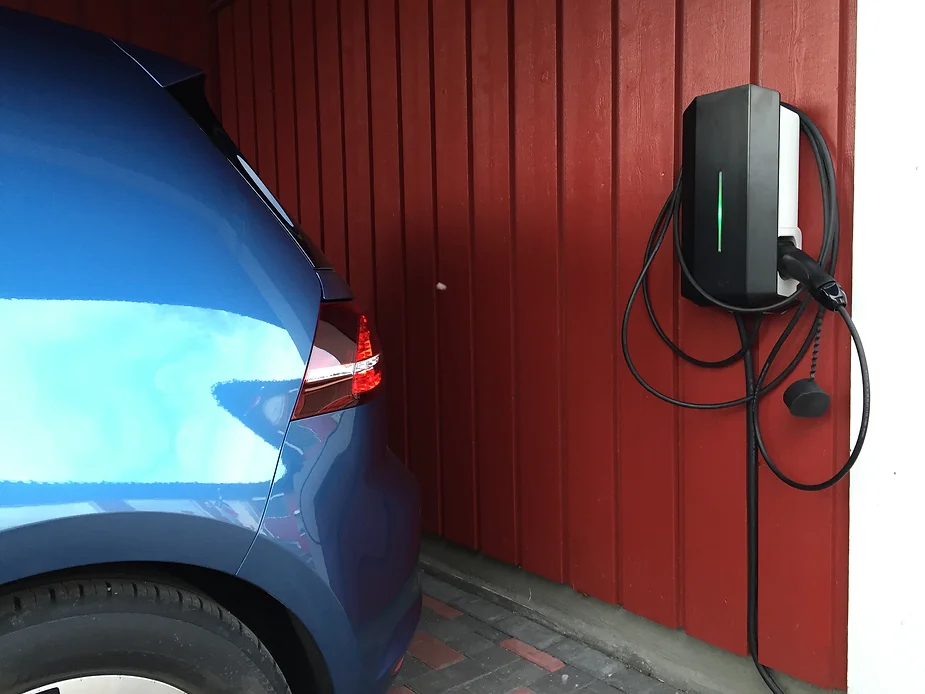
It’s not really about range or performance. It’s about routine. Once charging becomes something you do at home overnight, the whole business of “fuel stops” more or less disappears from your week.
You park, plug in, head inside, and get on with your evening.
After a while, you stop thinking about it altogether — in the same way you don’t think about charging your phone anymore.
For someone commuting 70–100km a day — say from Kildare or Meath into Dublin — diesel costs can easily sit around €350 to €450 a month. Charging overnight on a night tariff brings that down in a way that’s noticeable pretty quickly when bills come in.
That’s usually the point where curiosity turns into serious consideration.
Why Home Charging Changes the Numbers
Public charging is still useful, particularly for longer trips or if you’ve no driveway. But relying on it all the time tends to push costs back up.
At home, especially on night rates, charging is still where EVs make the most sense financially.
In broad terms, many drivers are covering 100km for somewhere between €2 and €4 worth of electricity. Compare that with €10–€15 in petrol or diesel and the difference becomes fairly obvious.
There’s also the practical side of it. You’re not calling into petrol stations on the way home, not checking prices, not deciding whether to “leave it until tomorrow”. The car is charged while you sleep, and that’s the end of it.
Solar Enters the Picture
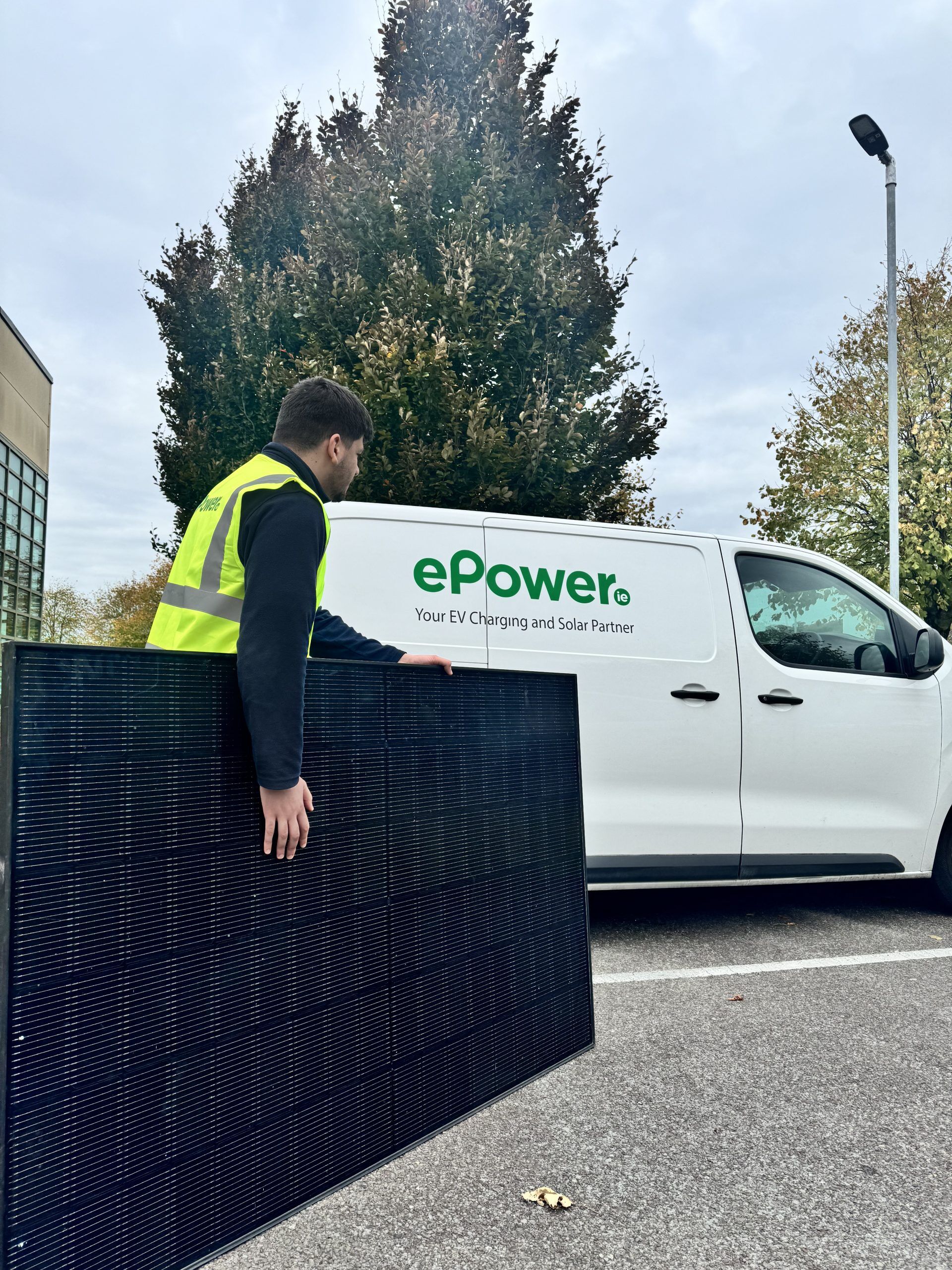
Solar panels have moved into more everyday conversations over the past couple of years. Not in a big dramatic way — more gradually, the same way people talk about insulation upgrades or replacing a boiler.
For EV owners, they add another angle.
Instead of buying all your electricity from the grid, you’re generating some of it yourself and using that during the day. It won’t cover everything, particularly through winter, but it can take a chunk out of both household usage and EV charging over the year.
Most systems here will contribute a decent amount from spring through early autumn. If the car is at home during the day, that lines up well. If not, people tend to combine solar with night-rate charging anyway.
It ends up being a mix rather than a perfect system, but it still reduces how much you’re paying overall.
Workplace Charging — The Obvious One People Still Overlook
There’s another piece of the puzzle that’s easy to miss.
Workplace charging while parking.
Cars sit there all day — sometimes eight or nine hours — and in many cases nothing is happening with them. Once a few people in the office start driving EVs, the idea of charging at work comes up naturally enough.
From a commuter’s point of view, it’s straightforward. Plug in when you arrive, leave with enough charge to cover the journey home and maybe the next day as well.
Some employers charge for it, some keep it free, some are still figuring it out. Either way, it tends to be simpler than relying on public chargers, especially if you’re already dealing with traffic on the M50 or a long run home.
It’s not something every workplace has caught up with yet, but once it’s there, it gets used.
Public Charging — Useful, But Not Where You Save Money
There’s still a perception that all EV charging is cheap.
Public rapid charging has become more expensive over time. In some locations, you’re looking at €0.60 to €0.75 per kWh. On a long motorway journey — factoring in tolls, coffee stops, and everything else — the cost difference compared to diesel isn’t as big as people might expect.
That doesn’t make it useless. It’s part of the system, especially for longer trips or if you’re caught short.
But most drivers who’ve lived with an EV for a while don’t rely on it every day. It’s there when needed, not something you build your weekly routine around.
The cheaper charging tends to happen quietly in the background — at home, overnight, or partly through solar.
What’s Actually Changing
What’s different this time isn’t just the price increases — it’s how people are reacting to them.
There’s less talk of “waiting for prices to come back down” and more people sitting down and looking at their monthly costs properly. Fuel, electricity, tolls, childcare runs, commuting — it all gets added up.
And once you start doing that, fuel stands out fairly quickly.
For households with two cars, or anyone covering serious mileage during the week, the idea of moving at least one of those cars to something cheaper to run starts to make practical sense.
That’s where home charging, solar, and workplace charging start getting looked at together, not separately.
Not as a big lifestyle shift, just as a way of getting the monthly outgoings under a bit more control.
Final Thoughts on EV Home and workplace charging and Solar
EV ownership still depends a lot on access to straightforward charging.
If that part is sorted — at home, at work, or a combination of both — the experience is usually much easier than people expect going in.
Solar adds another layer, but it’s not essential for the basic savings to show up.
Over a few years, the difference between running a diesel daily and charging an EV at home can be significant, particularly for drivers doing big mileage every week.
A few years ago, home chargers didn’t come up in normal conversations. Now they’re mentioned alongside things like renovations or changing cars. It’s been gradual, but it’s noticeable.
If you’re looking at home charging, workplace chargers, or trying to figure out whether solar makes sense alongside an EV, ePower can talk you through the practical side of it — what works, what doesn’t, and what actually suits the way you drive.